Therapy and the Violence of Getting Help
An essay about how therapy can help you, its limits on what it can actually fix, and how it can harm.

Updated • read

Table of Contents
Depictions of death, depression, poverty, suicidal ideation, threats of police
Therapy (in the context of mental health) attempts to help patients struggling with their mental health.
Some consider it as the end-all-be-all, the solution to mental health. Avoiding it is looked down upon, as therapists are seen as all-knowledgeable. But is that true? What are its limits of how therapy can or can’t help?
I’ll be telling a short story of my former private therapist I’ve visited for over a year, how that harmed me, and ways I see as to how to move on past it.
How I got to know my former therapist
Section titled How%20I%20got%20to%20know%20my%20former%20therapistI’ve tried doing a lot of various free therapy sessions from many places. There’s always some kind of problem though that I can’t seem to solve; I’m always still very anxious, and for the last while fairly depressed at the time.
I figured maybe I should spend a non-trivial amount of money for me, for on-going long-term therapy, and see if it could help me.
A lot of sessions were going through various things I already knew. I understood the concept of a distorted view of the world, that can happen via depression. I understood how to analyse beliefs, then defuse the false ones that come out of it.
Most of the time, I’m just trying explain why I feel a certain way, of how disability affects me, and how life can be crushing and devastating. Initially I learned a good chunk of DBT, however, it became repetitive, and I replied repetitively on its limitations of how much it can help.
How therapy is supposed to work
Section titled How%20therapy%20is%20supposed%20to%20workA therapist’s job is to help guide you through these therapies. Honesty is encouraged in therapy, as it helps give a better picture of what’s going on in the client’s life. Leading experts agree that honesty is important; how else are you going to solve problems if you can’t be honest with a therapist?
Except when it’s not, turns out.
The reason why you should be dishonest, is because they uphold the “duty to warn”. This is an ethical obligation, but also has legal roots in the Supreme Court. This applies to not just harm to others, but harm to self.
And getting involuntarily hospitalised isn’t pleasant.
At some point, this former therapist determined that I needed to be forcibly hospitalized, when I didn’t. This was frankly aggravating. I cannot even report them to any association, as Manitoba doesn’t regulate counseling. It doesn’t help that they have no online presence; an indicator I see now as bad.
Even if studies say that screening processes such as the Columbia-Suicide Severity Rating Scale (C-SSRS), these disregard the agency interest of the individual wanting to commit suicide; their life, their choice. Although the marginalised are most affected by suicide, the right to life—of choice—cannot be detached from the right to death.
But for now, the state dictates who gets to live and die, thinking they know best for the individual. Cops can and will be used to stop someone from killing themselves, using more violence to add to the violence of existence. My therapist threated the power of the state, rendering me powerless.
So then, what happens if the state gets what they want?
I get involuntarily hospitalised
Section titled I%20get%20involuntarily%20hospitalisedI was forced into visiting the Crisis Response Centre (which I’ll abbreviate to just the CRC) in Winnipeg. This place was very little help, and was not a good experience.
The first time was not because of my former therapist, but because of a friend concerned for me, driving me there, and tricking me. After uncomfortable talks with their staff, staying overnight, and being very careful of my words, I made it out with a pamphlet.
Of the Crisis Response Centre.
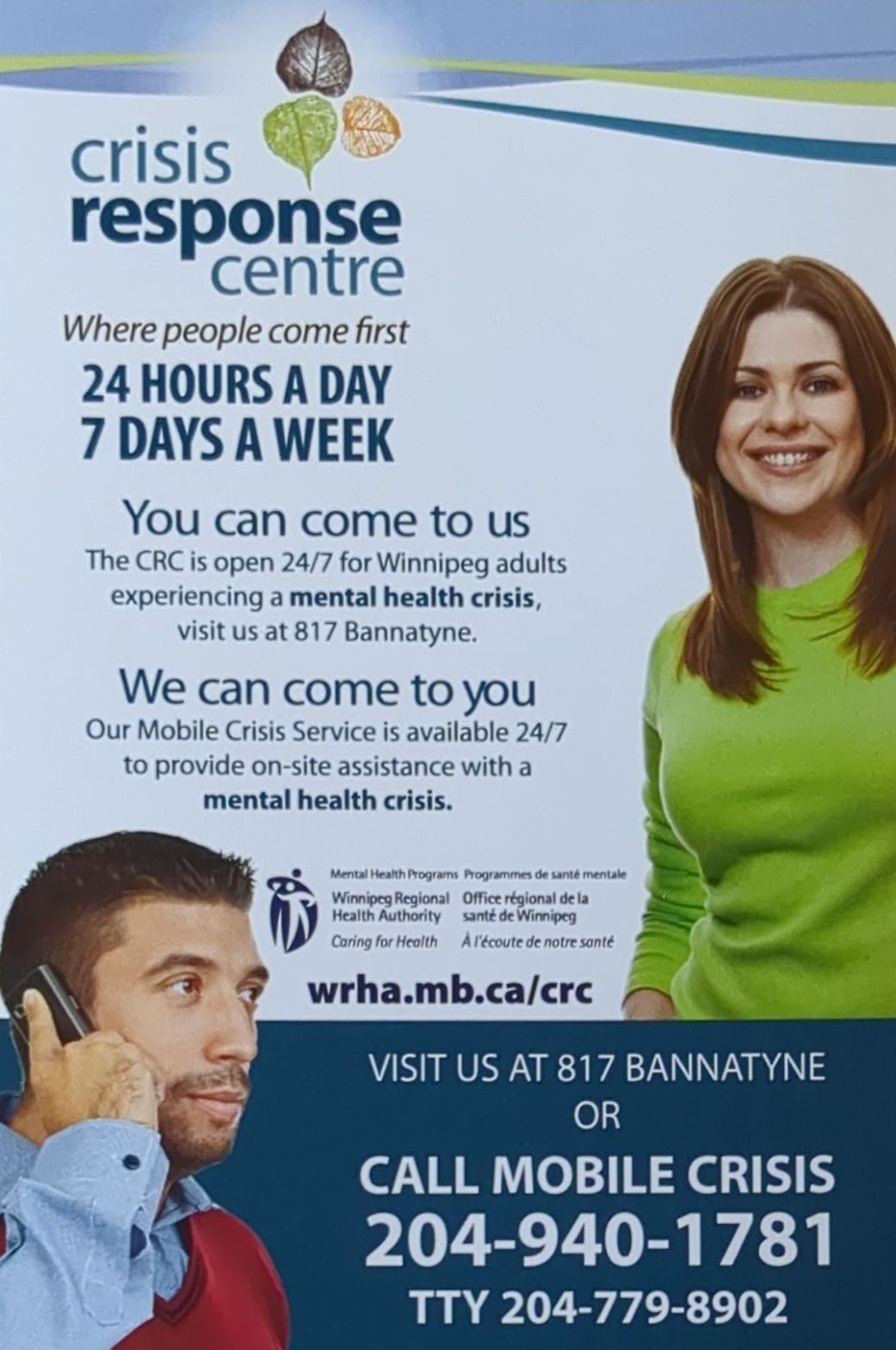

Nothing came of that visit but to waste my time and make sleeping more harder.
Perhaps that was an outlier, though. Luckily for me, I got to test it out again!
The second time was because of my former therapist. They threatened to call the police on me if I didn’t comply. This was frustrating for me, as it stripped me of my own freedom and agency; especially without reasonable threat, in my case.
The second time at least lead me to a CBTm group, However, considering my base knowledge of CBTm and DBT techniques beforehand, this isn’t much of a help. It also involved hours of waiting.
It also didn’t help that with staff member I was supposed to talk with, I felt like I was being talked down to and played with. I’ve however had a good experience with the peer support worker there, being able to ramble away my problems to someone who would actually listen.
The effects of involuntary hospitalisation
Section titled The%20effects%20of%20involuntary%20hospitalisationI’m sadly not alone in my experience; a study on the impact of involuntary psychiatric hospitalisation for youth and young adults, found many adverse effects. This includes many participants “not infrequently” described their experiences as “traumatic” or “damaging”. Themes of “unmet expectations” and “unaddressed needs” in this study also scream what I’ve experienced in this system.
Those of which who were part of the “intact trust group” only made 1/4th of the study’s findings, and even then, the response ranged from positive to mixed. Otherwise, the 3/4th majority was part of the “distrust” group.
Half of the distrust group reported feeling “scared”, “unsafe”, and “terrified”, which also correlates to my experience of discomfort when first entering the building. Walking in, your immediate interaction is to go through security through a metal detector, then after sitting down you get to watch security patrol over the place.
One thing about the “in-tact” study group’s theme stood out to me; “Bonding with other patients (versus staff).” I’ve also had a really nice experience like this, making small talk and sitting with someone in the waiting room, before they had to go.
Therapy’s goals
Section titled Therapy%E2%80%99s%20goalsLet’s take a look back, and see what therapy is, and what it’s meant to do.
The general goals of modern western therapy (or if I remember Dr. Alok Kanojia right) is generally to treat symptoms, rather than prevention. From my understanding, it also does this rather well.
When it’s useful
Section titled When%20it%E2%80%99s%20usefulCBTm, at least in the form of Healthy Gamer videos, helped me realise certain thought patterns. There’s thought patterns that I have about myself that don’t actually make sense in reality.
This especially applies in cases with my understanding of neurodivergence. For example, I see that someone struggling with ADHD doesn’t make them ‘broken’ or ‘worthless’. Many talk about their experiences with it, how it can affect their life negatively, and how good it can get when given the right environment.
Then, with CBTm, it could be applied to myself; I struggle with ADHD, and that doesn’t make me broken or worthless. I just need to find and/or create a better environment for myself.
From things like this, the long process of developing compassion for ones’ self, can have a foundation to build on.
When it’s not
Section titled When%20it%E2%80%99s%20notBut, if the reason why you’re depressed or anxious is based on society rather than your own thoughts, therapy’s effectiveness will be significantly lessened.
If you’re chronically stressed because you’re struggling to pay off credit card debt, while you’re seeing physical deterioration of your your body, because you’re putting in more time than you can handle, “mindfulness” of your anxiety can only help so much.
The source will still be there, even with grounding or breathing exercises. Your body may have blood coming out of both ends, and “reframing” your thoughts isn’t going to fix that you may have hours to live.
When techniques like CBT are used without context of your socioeconomic situation, of which you would have little to no control over, it can be dangerous and lead toward ignoring real problems.
On poverty
Section titled On%20povertyPoverty is not something traditional therapy can solve. If your suffering is based on economic stressors, like losing your home in harsh winters, or being unable to access food, reframing your thought may hurt or even kill you.
And no, I don’t think killing all poor people solves poverty, except for the mega-rich trying to up the price on their uninhabited housing properties.
Unfortunately also, poverty is a significant risk factor for mental health conditions, if not a leading cause.
We need individuals to be poor and unwell, in order for society to function. Their suffering helps perpetuate capitalism, to incentivise people to overwork themselves, trying to compete against one another.
As a society, are we going to fix this? Of course not. The billionaires that legally bribe politicians and lobby away our democracy, who benefit from the exploitation of the working class, have a strong incentive to never let this happen, at all costs.
If a universal basic income existed, enough to have everyone’s basic needs met, many workers would leave their exploitative jobs. Many jobs that exist currently are sadly, hurting or killing them, spiritually and physically. Very little would willingly subjugate themselves to these conditions, but capitalism incentives this under the threat of homelessness, starvation, and death.
A solution to this other than seemingly impossible political change, is to do social change ourselves. We can organise into communities and perform mutual aid, to help each other worry less about meeting our basic needs and live more fulfilling lives.
Improving outside therapy
Section titled Improving%20outside%20therapyAlthough therapy isn’t without some merit, if you’ve already got a good cover on manualised therapies such as CBTm or DBT, you may wish to consider the following options:
Vitamins
Section titled VitaminsThis is very often overlooked, and it seems pretty boring. But, having enough vitamins is essential.
If you feel tired, or depressed for no good reason (something akin to clinical depression), you may not be getting enough vitamins. This is not to say though that if you suffer from congruent depression, vitamins aren’t a relatively easy way to help your mood.
Vitamin D
Vitamin D, or “Vitamin D3”, is primarily gained from being in the sun. Being out in the sun for long enough, and especially consistently enough, is very difficult.
Vitamin B12
If you feel tired all the time, and struggle to get out of bed, you may also not be getting enough vitamin B12.
A way to obtain enough of these vitamins is picking specifically choosing foods high in these. Taking multivitamin gummies or other types of vitamin supplements, are an easy way to guarantee you’re getting enough of those vitamins.
This is even lower risk verses medications. It sure wouldn’t hurt (ignoring the occasional cost of buying supplements), unless you’re taking more than what the bottle recommends.
Community
Section titled CommunityFinding community can be tough, especially if you live farther from the city centre.
If you’re able to find individuals you’re able to go do exercise together, I highly recommend it! Studies have shown the benefits of exercise on mental health. Unfortunately this can be fairly inaccessible to be able to do, especially alone when it comes to motivation.
I’ve been in and out of some communities, and I’ve realised that the times I feel best is when I’m able to properly integrate into one. When I’m not, I feel lonely and isolated, which seemed to be a major factor in my own depression.
Queer Winnipeg has a new Discord server if you’d like to join!
Medications
Section titled MedicationsMedications prescribed by a doctor can be used to treat depression and anxiety. Sertraline is a commonly-prescribed selective serotonin reuptake inhibitor, otherwise known as an SSRI. This medication is for treating anxiety and depression.
Side effects tend to be numerous for such medications, including so-called “low side-effect” meds like sertraline. Some individuals report feeling numb, nauseous, fatigued, and lower sexual function.
In cases of congruent depression, medications are critisised for being used as a cover-all, instead of trying to solve the core issue.
Critics say that depression is not purely just a “chemical imbalance of the brain,” but rather can be a mix of socioeconomic problems that would cause one to be stressed and/or miserable. It would make sense that you’d be depressed, if you have “shit life syndrome” because your life is in-fact shit.
Regardless though, I recommend disclosing mental health conditions to your primary doctor. It’ll let them be able to rule in or out certain conditions, that may be affecting your life.
Recommended resources
Section titled Recommended%20resourcesAs someone who struggles with traditional mental health systems, I find things like YouTube videos and other accessible online resources more useful to learn from.
For an academic, philosophical view on mental health, you may find the following video (and the YouTubers) an amazing listen:
- are antidepressants political? - Ashton Daniel - Ashton talks about his experience of the carceral mental health system, in conjunction with transness, disability, and common political fears leftists have.
Otherwise, you may find these resources useful:
- Healthy Gamer - A vast wealth of mental health content, by an engaging speaker. Highly recommend the videos on how to communicate. More recent videos specifically target cis men’s issues, but general videos do exist.
- Dr. Alok Kanojia, founder of Healthy Gamer, is not without criticism however; see The Philosophy of Dr. K - Sisyphus 55. I’ve also personally not had a useful experience with their private group coaching.
- DBT Tools - A quick reference to many DBT techniques and skills, and how to do them.
If you’re looking for therapy, I’ve had alright experiences with Klinic’s drop-in and short-term counseling. It’s free, and they weren’t the ones to hospitalise me.
Crisis lines
Section titled Crisis%20linesI can’t say I personally recommend any crisis line, by one prior bad experience when I was vulnerable. The person on the phone made things worse, and they let me go too early. Sorry, guidelines about talking about suicide. If you’re desperate though:
- 9-8-8
- Klinic Crisis Line
- Phone: (204) 786-8686
- Toll free: 1-888-322-3019
- Trans Lifeline
- Phone (Canada): 1-877-330-6366
Final thoughts
Section titled Final%20thoughtsThere’s a phenomenon on social media that berates men, saying that “men will do literally anything than go to therapy”. However, therapy may not actually be helpful for them, and it may be unproductive as a society to imply that you should.
I am quite far away from being able to find and cite academic research very well (if it wasn’t obvious that I link a YouTube video, claiming a very strong fact, without citation on-screen), so take what you’ve read with a grain of salt. This type of article, where I cite sources and not talk purely out of my ass, is very much outside my wheelhouse.
Special thanks to The Leftist Cooks, with their video Do Your Research: How To Understand Academic Studies on YouTube. This article would not have been possible without it.