How to Start HRT in Winnipeg
Looking to medically transition here in Winnipeg? This guide will show you how to get hormone replacement therapy (HRT) as fast as possible.


Updated • read

Table of Contents
As you may already know, hormone replacement therapy (HRT) is important for many trans individuals. Getting access to this for some is life-saving. But how do you get on HRT? This article will cover both going through your primary care practitioner and Klinic.
Filling out Klinic intake forms
Section titled Filling%20out%20Klinic%20intake%20formsKlinic Community Health is an organization that provides many health services, including helping you medically transition.
They can help you not only with HRT, but if you choose, referrals for gender-affirming surgeries, seeing a speech language pathologist to change your voice, and getting laser hair removal from the neck up, all for free!
To register, you have two options:
Go fill out the intake form on this page, print it, then either:
- Hand it in via physical mail
- Drop it off at the front desk
Go to Klinic physically, then ask the front desk for the trans health intake form to fill out. They will give you a clipboard, and you can pick up a sanitized pen to the left of the front desk.

The Trans Health Klinic intake form. Please contact us if the link leads to a “not found” page, so we can fix it.
Their address is 167 Sherbrook St., and this address can be found at the bottom of the page, under “Contact Us”.
If you feel it’s unsafe to ask for parents for a ride there, and you don’t have a vehicle, here’s what you can do; you can buy bus tickets nearby, then transport yourself to Klinic using the bus routing on Google Maps.
If you’re not familiar with taking the bus, and need some help, check out How to Take the Bus in Winnipeg.
Depending on how you wish to be communicated with, you will receive a phone call confirming that you’re on the wait list.
Finding a family doctor (optional)
Section titled Finding%20a%20family%20doctor%20(optional)You don’t need a family doctor to start hormones! Klinic usually is enough to start.
Having one though can speed things up significantly, sometimes just from one appointment, compared to a year. Klinic will also want to transfer you to your family doctor after a year under their care.
See if you have a family doctor already. If you’re young and it’s safe, you can ask your parents if you do have one.
If its unsafe to ask, or your current doctor themselves may be unsafe, or for any other reason, you can go to the Family Doctor Finder to find a new family doctor.
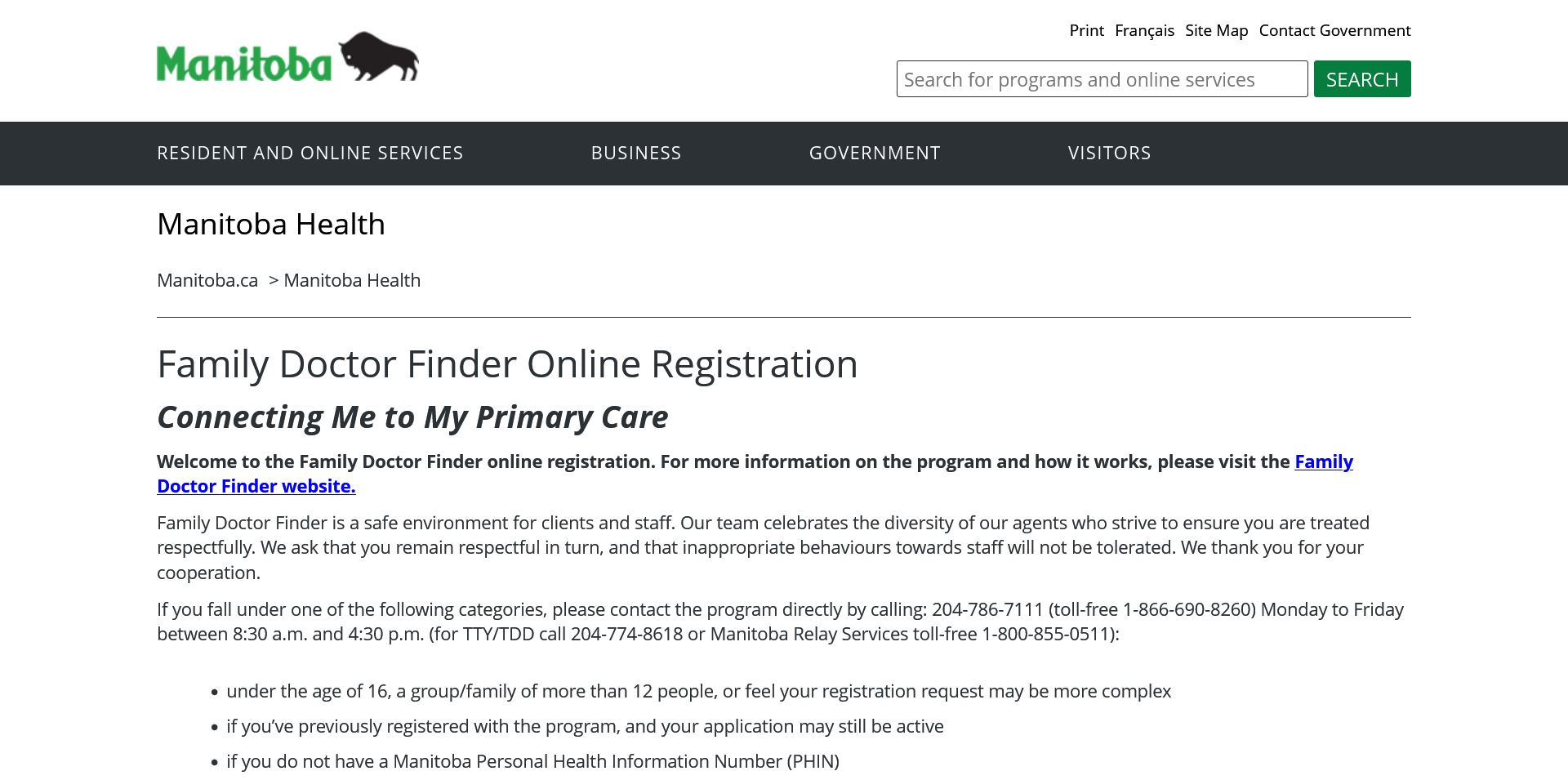
The Family Doctor Finder website
The recommendations that the author of this article has heard from a nurse practitioner at Klinic, is the following:
Many of the above may not be accepting new patients at this time, especially Our Own Health Centre. They should however still be providing walk-in services, as of writing.
If you get your hormones through Klinic, after a year on HRT, they’ll want to transfer you to your primary care provider. If you don’t have one by that one year however, they’ll still prescribe you HRT.
Alternative to family doctor
Section titled Alternative%20to%20family%20doctorIf you’re younger than 30, Huddle’s walk-in services may be able to provide for you, via medical practitioner appointment. As of writing, Norwood is struggling to find a medical practitioner, but theoretically all Huddle locations are able to prescribe HRT.
For known good locations, this includes Huddle’s Broadway and South Central locations.
Approaching your family doctor about starting hormones (optional)
Section titled Approaching%20your%20family%20doctor%20about%20starting%20hormones%20(optional)This only applies if you’ve found a family doctor. If Klinic gets to you first, you can safely ignore this section.
Filling out the informed consent form
Section titled Filling%20out%20the%20informed%20consent%20formThere are two separate forms for getting estrogen and testosterone. If you’re transfemme, you likely want estrogen. For transmascs, you likely want testosterone.
Once you’ve read over it, print it and fill it out!
Tip for transfemmes: you can get progestin prescribed with a separate form. It’s best practice to wait for roughly a year or so, before adding progestin to your regimen.
If you know your doctor’s going to be good about prescribing you HRT, you may not need to give them the informed consent sheet.
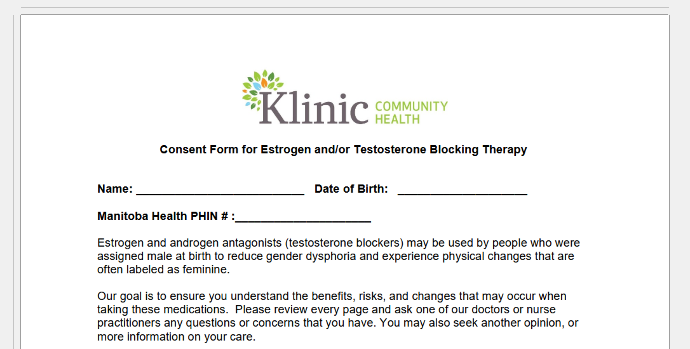
Note that the intake form and the consent form are different!
If the link is broken, you may be able to get the document in the “Health care providers” section of the Trans Health Klinic. This is under “Medical Forms”.
Public libraries have on-demand print services for a fee, if you need access to a printer. For black and white printing, it is 10 cents by cash. If you don’t have change, you can talk to staff and they’ll help you out. Otherwise, if you can meet a peer support worker at Klinic, you can ask them to print it for you.
Handing the informed consent form
Section titled Handing%20the%20informed%20consent%20formIf you have found a family doctor, you can then schedule an appointment to them!
Some medical clinics may use Medeo, where you can schedule an appointment online. Otherwise, phone calls will likely be an option.
Hand in that sheet at your doctor’s appointment, and say “Klinic wants a doctor to start treatment before they take care of me. The guidelines are on their website and I want to start now if possible.”
If Klinic gets to you first, they will give you an informed consent form to read over and sign.
What do you do if your doctor refuses?
Section titled What%20do%20you%20do%20if%20your%20doctor%20refuses%3FIf the informed consent sheet is signed, your doctor has no reason not to continue with treatment. If they refuse due to inexperience, you can refer them to the following resources, that don’t require any special knowledge or prior experience to follow:
- British Columbia’s Provincial Health Services Authority:
- International guidelines:
These documents are what Klinic bases their care off of, as detailed by their Welcome Package.
It’s worth noting these guidelines tend to lean quite conservative with dosages and blood levels. This is opposed to many advocates in the DIY HRT community saying there isn’t any real reason to start with low dosages.
The transfemme guide, A Practical Guide for HRT by Katie Tightpussy, advocates for getting estradiol levels of 730 pmol/L (200 pg/ml) minimum. Klinic, from Fio’s experience, tend to target lower levels by default (~200-800 pmol/L), and starts off very low on dosage. One practitioner at Klinic expressed that the 730 pmol/L target is too high, and is more likely to cause more issues rather than help.
But, if you’re aiming for certain levels, express this to your nurse practitioner, and they will help and/or explain their thought process.
It is also worth pointing out, as Katie’s guide points out: any [hormones] is better than no [hormones].
If they deny you treatment (ex. outright, or redirecting you to Klinic anyway) you can explain to them that you legally signed that you are informed, have given your consent, and would like to start treatment.
If they refuse again, you should insist they continue with treatment, or have them find a new doctor that will. This is an ethics violation, and you should report that to The College of Physicians & Surgeons of Manitoba (CPSM).
As Klinic used to out on their own health care provider’s page:
[…] we encourage you to support your client by initiating hormone therapy because it’s within your scope of practice as a primary care provider and “there is a potential for harm by denying access to appropriate treatments” (The Standards of Care V7, World Professional Association of Transgender Health, 2011, p.55).
To deny care can cause undue harm to a patient, along with discrimination as you are trans and seeking care for that. If you need a new doctor, go back to the family doctor finder to find a new doctor.
If you need help navigating the complaint process, you can email the Ombudsman, and they’ll be able to help you.
You can also use RateMDs or Review My Doctor to warn others who may be seeking a doctor.
Blood tests
Section titled Blood%20testsIn the process of being on HRT, you will be required to do a blood test roughly every four months. A nurse will take a blood sample usually from a vein in your arm, and will roughly take five minutes.
If you’re squeamish with needles, mention this to the nurse drawing your blood. One strategy is to look away, and attempt to distract yourself. A nurse may ask you questions like “what do you plan to do after?”, which can prove very effective. You may also find that looking at the needle while being inserted is more comfortable. If you know that you faint when your blood is drawn, also let them know.
There may also be food available to help your blood replenish, such as juice boxes and crackers. Klinic has these usually on reserve, so feel free to ask for it!
Pharmacare (optional)
Section titled Pharmacare%20(optional)If you’re low income, and especially if you don’t have insurance, apply for Pharmacare! Pharmacare may save you hundreds of dollars! It bears repeating; hundreds.
Navigate to the article above, for a guide on whether you are eligible for Pharmacare (which is very likely), and how to apply.
If you qualify for the Non-Insured Health Benefits (NIHB) program, you may get gender-affirming medications fully covered. This generally only applies to First Nations people and Inuks. See Who is eligible for the Non-Insured Health Benefits program for more info.
Otherwise, the national pharmacare program should cover some HRT medication expenses. As of writing, estradiol and progesterone is covered, but not anti-androgens such as cyproterone or spironolactone.
It also doesn’t appear that testosterone is covered via the national Pharmacare system, although the provincial Pharmacare system should cover it if you apply.
Purchasing prescription medications
Section titled Purchasing%20prescription%20medicationsIn order to obtain prescription medication, you’ll need to go to a pharmacy.
Costco Pharmacy is known for having the cheapest prices. You do not need a Costco membership to use the pharmacy; when an employee in the front asks for membership, say you’re going to the pharmacy, and they’ll let you go.
Otherwise, go with a pharmacy that’s most accessible. The price difference is not very big. Prices will likely not matter much if you’re under Pharmacare and/or have insurance.
For transfemmes, expect your first prescription to be roughly $25 for the cost of anti-androgens/testosterone blockers.
If you’re insured by your parents, and you’re not out to them, be warned; by using your parents’ insurance, your insurance will notify them that it’s been used for your medications!
These will come in a paper bag, with a stapled receipt. If your living situation is unsafe, make sure to have a stealthy place to store it!
Taking HRT for the first time
Section titled Taking%20HRT%20for%20the%20first%20timeIf your pharmacist hasn’t discussed how to take your medications for the first time, read the prescription bottle. It will contain a short snippet, likely saying to take it daily if you’re on oral estradiol.
For transfemmes, your routine may involve taking estradiol at night, and spironolactone in the day to avoid needing to urinate at night.
Although horribly dense and with lots of irrelevant info, your first-time prescription will contain an informational paper about your medications. Along with really scary potential (but very unlikely) symptoms to watch out, it’ll have info on what to do, if you forget to take your medications at specific times.
To help you remember, you can set up recurring tasks in your calendar to make sure you take your medications at the right time.
Once you’ve taken the medication for the first time, congrats! Mark the date, as it will become an important one on your transition journey.
What next?
Section titled What%20next%3FEven if you’re on HRT, you may still wish to talk with Klinic. This is because if you want to be referred for certain health services, you’ll likely want to do it through them.
This includes laser hair removal for the face and neck (sometimes chest), voice training, and upper, gonadectomy, and lower surgeries.
For all the procedures/surgeries that exist, the most up-to-date list the Queer Winnipeg team is aware of, is a 2025 snapshot of Klinic’s old website. For your convenience, its contents have been posted here with known changes since then:
| Procedures | Where is it performed? | Coverage |
|---|---|---|
Laser Hair Removal:
| Winnipeg | Covered |
| Voice training | Winnipeg (Deer Lodge Centre) | Covered |
Upper surgeries:
| Winnipeg | Covered |
Gonadectomy surgeries:
| Winnipeg | Covered |
Lower surgeries:
| Montreal (Centre de Chirurgie) | Covered |
| Tracheal/Adam’s Apple Shaving | Winnipeg, Montreal (Centre de Chirurgie) | Not covered |
| Gender Affirming Facial Surgery | Winnipeg, Montreal (Centre de Chirurgie) | Not covered* |
| Electrolysis | - | Not covered |
| Gender gear | - | Not covered |
| Fertility treatments | Heartland Fertility Clinic | Not covered (tax credit available) |
| Legal name & gender marker change | Manitoba | Costs involved; EIA participants can obtain coverage one time only |
| Hormones | Trans Health Klinic, Your primary care provider | Depends on medications, alongside national pharmacare/private insurance/EIA/Treaty |
*Facial surgery should be covered, however the Manitoba provincial health care system seems to be dragging their feet. See: CBC.ca - Trans woman says Manitoba Health won’t tell her whether they’ll cover gender-affirming surgery.
Its also worth noting that I’ve heard cases where laser is covered for the chest, if requested.